Will Claude get more expensive? Could your usage limits change? And what happens when AI agents start doing more of your work? Anthropic’s latest IPO prospectus offers some revealing clues—though not necessarily the answers you might expect.
On November 10, 2026, Anthropic announced the launch of the roadshow for its proposed initial public offering. The company plans to offer 825 million shares of Class A common stock, with an expected price range of $70 to $78 per share, and has applied to list on Nasdaq under the ticker ANT.
As of November 16, the offering remains proposed, and its registration statement has not yet become effective. Anthropic
For investors, the discussion will likely center on valuation, revenue growth, and whether Anthropic can build a profitable business.
But if you’re one of the people who actually use Claude every day, you probably have a different set of questions.
Will your subscription get more expensive? Will you still be able to use Claude Code as much as you do today? Could the company introduce more restrictions as it tries to balance growth with profitability?
And perhaps most importantly, will Claude remain a predictable service that you can depend on for your work?
This analysis reviews Anthropic’s November 10 prospectus from the perspective of Claude users. Rather than focusing on the stock offering itself, I wanted to understand what the filing tells us about the economics behind the products we use.
The document doesn’t announce new subscription prices or upcoming usage restrictions. What it does reveal is how Anthropic makes money, why AI agents are particularly expensive to operate, and how the company thinks about the resources needed to support growing demand.
Here are seven things that stood out.
1. Will Claude become more expensive? The filing doesn’t say, but its revenue model is revealing.
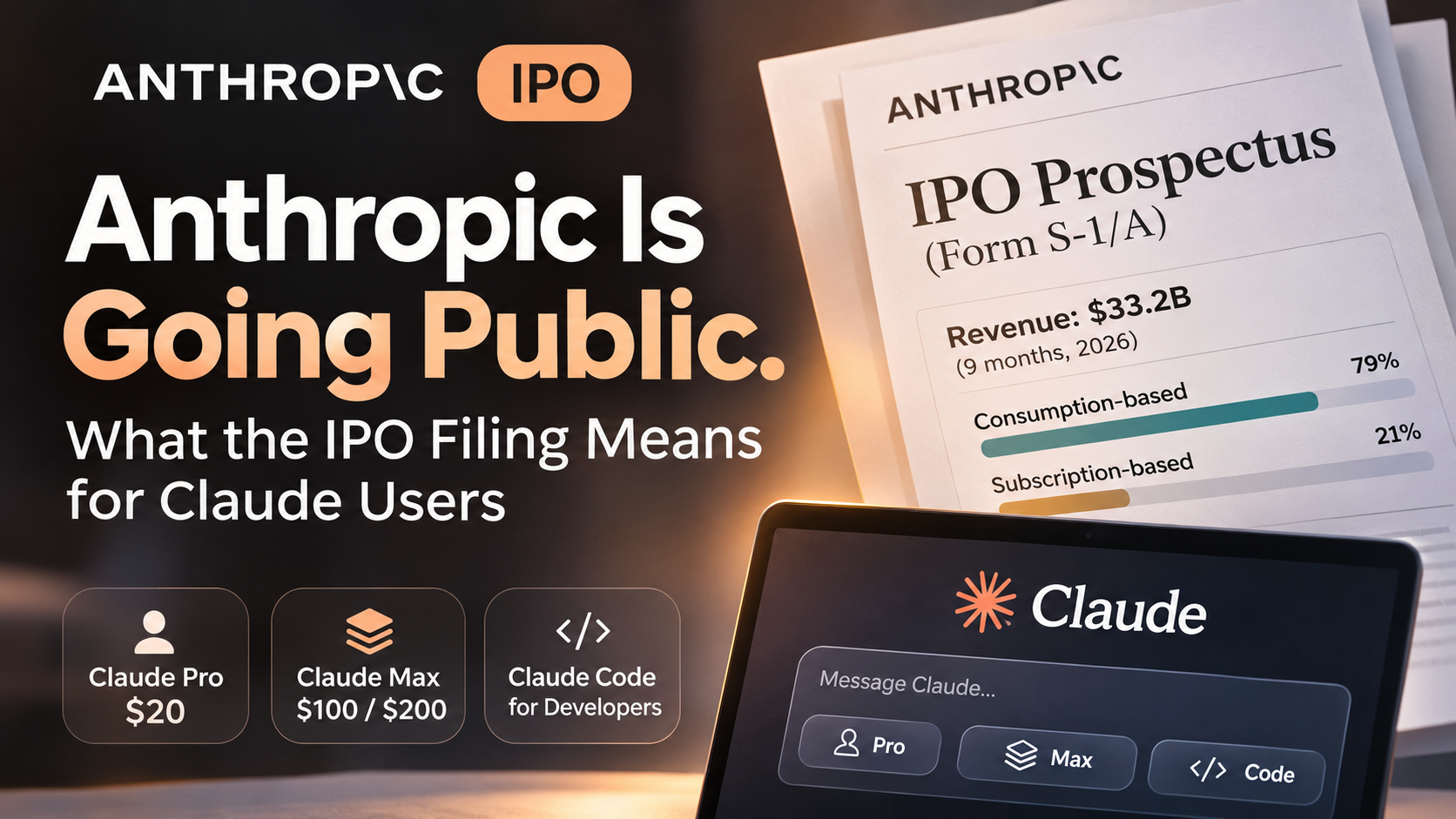
One of the most interesting disclosures in the prospectus is how much of Anthropic’s revenue comes from usage-based billing rather than subscriptions.
For the nine months ended September 30, 2026, Anthropic reported:
That means the majority of Anthropic’s business is already built around customers paying for the intelligence they consume, rather than simply paying a fixed monthly fee.
The distinction matters.
With a subscription, you pay a predictable amount in exchange for a defined set of capabilities and usage allowances. With consumption-based billing, spending scales with how much you use the service.
Anthropic also describes how these models can work together. Subscribers who approach or exhaust their included usage capacity may move to a higher subscription tier or purchase additional usage.
This creates a commercial path from a fixed monthly subscription to additional consumption-based spending. Anthropic
Does that mean Anthropic plans to replace Claude subscriptions with pay-as-you-go pricing?
No. The prospectus makes no such announcement.
But it does suggest that the company sees subscriptions and consumption-based billing as complementary rather than competing models.
For ordinary users, the important question may eventually become less about the monthly subscription price and more about how much useful work that subscription actually includes.
A $20 or $200 plan is only as valuable as the tasks you can reliably complete within its limits.
2. Why does Claude have usage limits even when you’re paying?
If you’ve ever been interrupted in the middle of a Claude Code session because you reached a usage limit, the prospectus provides some useful context.
Anthropic explicitly states that subscriptions are subject to usage limits that reset over relatively short periods.
It also acknowledges something that many users have already experienced: the company has changed usage limits, rate limits, and product capabilities in the past, and may do so again.
Importantly, Anthropic identifies these changes as a business risk because they can affect customer satisfaction, perceptions of product value, and the company’s reputation. Anthropic
That last point is worth emphasizing.
Usage restrictions aren’t simply an inconvenience that Anthropic can impose without consequences. The company recognizes that changes to what customers can access may damage trust.
At the same time, AI services have a cost structure that makes usage limits understandable.
Unlike a traditional software subscription, where an additional action may require relatively little computing power, running a frontier AI model consumes computational resources each time it processes a request.
The cost can vary substantially depending on the model, the length of the context, and the complexity of the work.
This becomes especially important when users move beyond ordinary conversations into coding and autonomous workflows.
The prospectus doesn’t disclose the precise internal formula Anthropic uses to allocate subscription capacity among individual users. We therefore can’t calculate exactly how profitable or unprofitable a particular Claude subscription is.
What we can say is that usage limits are an explicit part of Anthropic’s subscription model, and the company has retained flexibility to adjust them.
That is different from saying an IPO will cause stricter limits.
There is no disclosed basis for that conclusion.
3. Claude Code and Cowork could change what an AI subscription is actually worth.
For many people, Claude is no longer just a chatbot.
Claude Code can help write and modify software, navigate repositories, and work through multi-step development tasks. Claude Cowork extends the idea of an AI collaborator into broader knowledge-work activities.
Anthropic identifies both products as important parts of its application business in the prospectus. Anthropic
The significance is that these products change the nature of AI consumption.
Consider two hypothetical interactions.
In the first, you ask Claude to summarize a document. It processes the request and produces a response.
In the second, you ask an AI agent to investigate a software bug, examine multiple files, propose a solution, modify the code, and verify whether the changes work.
The second task may involve repeated model calls, tool use, intermediate reasoning, and additional attempts when something fails.
The amount of work performed by the system can be much greater than what is visible in the final answer.
This creates a challenge for fixed-price subscriptions: two customers paying the same monthly amount may consume very different quantities of computing resources.
It also creates an opportunity.
An AI agent that saves someone several hours of work can deliver substantially more practical value than a chatbot that simply answers questions.
That may support higher spending among customers who depend on these capabilities, even if the underlying cost per task improves.
The prospectus doesn’t establish what Claude Code or Cowork subscriptions will look like after the IPO. It also doesn’t establish that agent features will necessarily become more expensive.
But it makes one broader development clear: Anthropic is building a business in which AI increasingly performs work rather than merely generates responses.
For users, that suggests a better way to evaluate AI subscriptions.
Instead of asking only how many messages a plan includes, ask how many meaningful tasks it allows you to complete.
That is a much more useful measure of value.
4. Anthropic needs enormous computing capacity. What does that mean for users?
One of the most striking parts of the prospectus has little to do with subscriptions.
It’s about infrastructure.
Anthropic explains that much of its computing capacity is secured through multi-year agreements, typically arranged 12 to 18 months before the resources become available.
When demand exceeds that planned capacity, the company may need to purchase additional computing resources on shorter notice, at significantly higher prices.
As of and subsequent to September 30, 2026, Anthropic disclosed approximately $900.9 billion in aggregate purchase commitments and lease agreements, including commitments extending well into the next decade. These are contractual commitments across multiple years, not expenses already incurred or cash that must be paid immediately. Anthropic
Why should an ordinary Claude user care?
Because delivering AI services requires Anthropic to balance three things simultaneously: the number of people using its models, the computing resources available to serve them, and the cost of providing those resources.
A sudden increase in demand doesn’t necessarily mean the company can immediately add equivalent capacity at the same cost.
This helps explain why AI companies need mechanisms such as usage allowances, rate limits, and different service tiers.
It also suggests that product availability and capacity planning are closely connected.
However, there’s another side to the equation.
More efficient models can reduce the computing resources needed to complete a task. Anthropic has already described efficiency improvements in its model releases, including its September 2026 announcement that Opus 5.5 costs approximately 40% less to run than Opus 5 on typical workloads. Anthropic
That doesn’t automatically translate into a 40% reduction in subscription prices or user costs. But it demonstrates why higher usage doesn’t necessarily require costs to grow at the same rate.
The outcome depends on both sides of the equation: how quickly AI usage expands and how efficiently that work can be performed.
For users, the most reasonable conclusion is that capacity and efficiency will continue to influence the services Anthropic can offer.
The filing does not establish whether that will result in higher prices, more generous allowances, or a combination of both.
5. As Claude becomes more autonomous, who is responsible when something goes wrong?
This is one of the more consequential questions raised by the prospectus.
A chatbot that gives an incorrect answer can cause problems. But an AI agent that takes actions on a user’s behalf introduces another level of complexity.
Imagine an agent modifying important code, changing files, or interacting with external systems. An incorrect action may have consequences beyond the conversation itself.
Anthropic explicitly discusses these risks in its filing.
The company acknowledges that the legal frameworks governing liability for autonomous AI systems remain unsettled. It also identifies uncertainty about when an AI agent’s actions could create binding obligations for a user or organization. Anthropic
This is not an admission that Claude routinely performs unauthorized actions. It is a disclosure of potential risks associated with increasingly autonomous systems.
Still, the implications for users are significant.
As AI tools gain the ability to perform more complex tasks, questions about permissions, supervision, accountability, and recovery become more important.
For example, if you allow Claude to modify a software project, it makes sense to maintain version control and review consequential changes before deploying them.
If an AI agent is working with sensitive documents or external accounts, its access should be limited to what the task actually requires.
These precautions are useful regardless of which company provides the AI.
The broader point is that the value of an AI agent increasingly depends on more than its intelligence. Reliability, transparency, and the ability to maintain meaningful human control are becoming part of the product itself.
And unlike subscription pricing, this is an area where Anthropic’s IPO filing directly acknowledges substantial legal uncertainty.
6. Will going public change Anthropic’s commitment to AI safety?
Anthropic has positioned responsible AI development as a central part of its identity.
That raises an obvious question: will the pressure to satisfy public-market investors change how the company approaches safety?
The prospectus offers an unusually detailed explanation of Anthropic’s governance structure.
Anthropic is incorporated as a Delaware public benefit corporation. Under this structure, its directors must balance stockholder financial interests, the interests of those materially affected by the company’s conduct, and its stated public benefit purpose.
The company also maintains a Long-Term Benefit Trust, which generally has the authority to elect and remove directors who together constitute a majority of the authorized board.
Separately, Anthropic’s founders are expected to hold 50.1% of the company’s general voting power through a special class of stock after the offering. Anthropic
These arrangements are designed to preserve the company’s ability to pursue its stated mission alongside commercial objectives.
But governance structures are not guarantees of particular outcomes.
The prospectus itself acknowledges that Anthropic may make decisions that affect short-term business performance in pursuit of longer-term objectives. These could include changes to product availability, deployment schedules, or the pace at which certain AI capabilities are released.
For ordinary users, that means a new model or feature might not always become immediately available simply because it is technically possible to release it.
Anthropic also describes circumstances in which safety evaluations could delay or limit the availability of certain capabilities. Anthropic
It would be inaccurate to conclude that going public will necessarily weaken Anthropic’s safety commitments.
It would be equally inaccurate to assume that its governance structure eliminates every potential conflict between commercial growth and responsible deployment.
What the filing establishes is that Anthropic has formally incorporated these considerations into its corporate structure.
How effectively that structure operates will ultimately be judged by the company’s decisions over time.
7. So what should Claude users actually do before the IPO?
After reading the filing, I don’t think ordinary users need to make dramatic changes simply because Anthropic is preparing to go public.
There is no announced post-IPO subscription price increase in the prospectus, no disclosed schedule for reducing Claude Code allowances, and no indication that existing subscriptions will automatically be replaced by consumption-based billing.
But there are a few practical things worth paying attention to.
First, evaluate subscriptions by the amount of useful work they support, not just the monthly price or the name of the model included.
If you use Claude occasionally for writing, research, or summarization, your requirements will be very different from those of someone running complex coding agents throughout the day.
Second, understand the difference between subscription allowances and additional usage charges. Anthropic’s business model explicitly accommodates both, and knowing which applies to your account helps keep spending predictable.
Third, avoid making critical work entirely dependent on a single AI service. Maintain copies of important outputs, keep software projects under version control, and make sure you can continue essential workflows if a model, feature, or usage allowance changes.
Finally, pay attention to official product announcements and service terms rather than assuming that every change is related to the IPO.
Anthropic’s prospectus identifies competition, computing capacity, customer expectations, product development, and safety requirements as factors affecting its business.
Any future product decision could involve several of these considerations.
Attributing every price or usage change to public-market pressure would be an oversimplification.
The bigger picture: We’re moving from paying for AI access to paying for AI work
The most interesting takeaway from Anthropic’s prospectus isn’t a prediction about subscription prices.
It’s the direction of the business.
Anthropic generates most of its revenue through consumption-based services. It is investing heavily in computing infrastructure. And products such as Claude Code and Cowork are extending Claude’s role from answering questions to performing increasingly complex work.
Together, these developments point toward a broader shift in how people may evaluate AI services.
For years, software subscriptions have generally been priced around access: access to an application, a set of features, or a certain number of users.
AI introduces another dimension.
The same application can consume dramatically different resources depending on what users ask it to accomplish.
A short conversation and a multi-hour agent workflow are not economically equivalent, even if both begin with a single prompt.
That creates a challenge for AI companies trying to offer predictable subscriptions while supporting increasingly capable systems.
It also creates a challenge for users trying to determine which subscription is worth paying for.
The question may gradually shift from How much AI can I use? to How much work can this AI reliably complete for the money I spend?
That doesn’t mean subscriptions are disappearing. Anthropic’s own filing describes subscriptions as an important and growing part of its business.
It means that the relationship between price, usage, and practical value is likely to become more important as AI agents take on larger responsibilities.
And that is why Anthropic’s IPO matters beyond Wall Street.
The company is entering the public markets at a time when AI is becoming part of people’s everyday work. Its future decisions about pricing, capacity, product access, and safety will affect more than its financial statements.
They will help shape what users come to expect from AI services.
For now, the prospectus gives us no reason to assume Claude will suddenly become more expensive or restrictive after the IPO. What it does give us is a clearer understanding of the economic and operational tradeoffs behind the service.
And for anyone who increasingly depends on Claude, understanding those tradeoffs may be more useful than trying to predict its stock price.
Sources and methodology
This article relies exclusively on Anthropic’s own disclosures and official publications. The primary source is its preliminary IPO prospectus dated November 10, 2026, filed with the U.S. Securities and Exchange Commission. The analysis also references Anthropic’s official IPO announcement and model-release information.
Disclosure: This article is an independent analysis of publicly available company disclosures. It is not affiliated with, sponsored by, or endorsed by Anthropic. Statements about possible future developments are analytical interpretations, not announcements of company plans. This article is provided for informational purposes and does not constitute investment, legal, or financial advice.

Leave a Reply