
Updated November 14, 2026
Google’s Gemini 4 family now includes three powerful AI models: Gemini 4 Hydrogen, Gemini 4 Argon, and Gemini 4 Carbon.
With Hydrogen launching on November 12, just two days after Carbon became widely available, Google has given users more choices than ever. But those choices also raise an important question: Which Gemini 4 model should you actually use?
The answer isn’t as simple as picking the most powerful model.
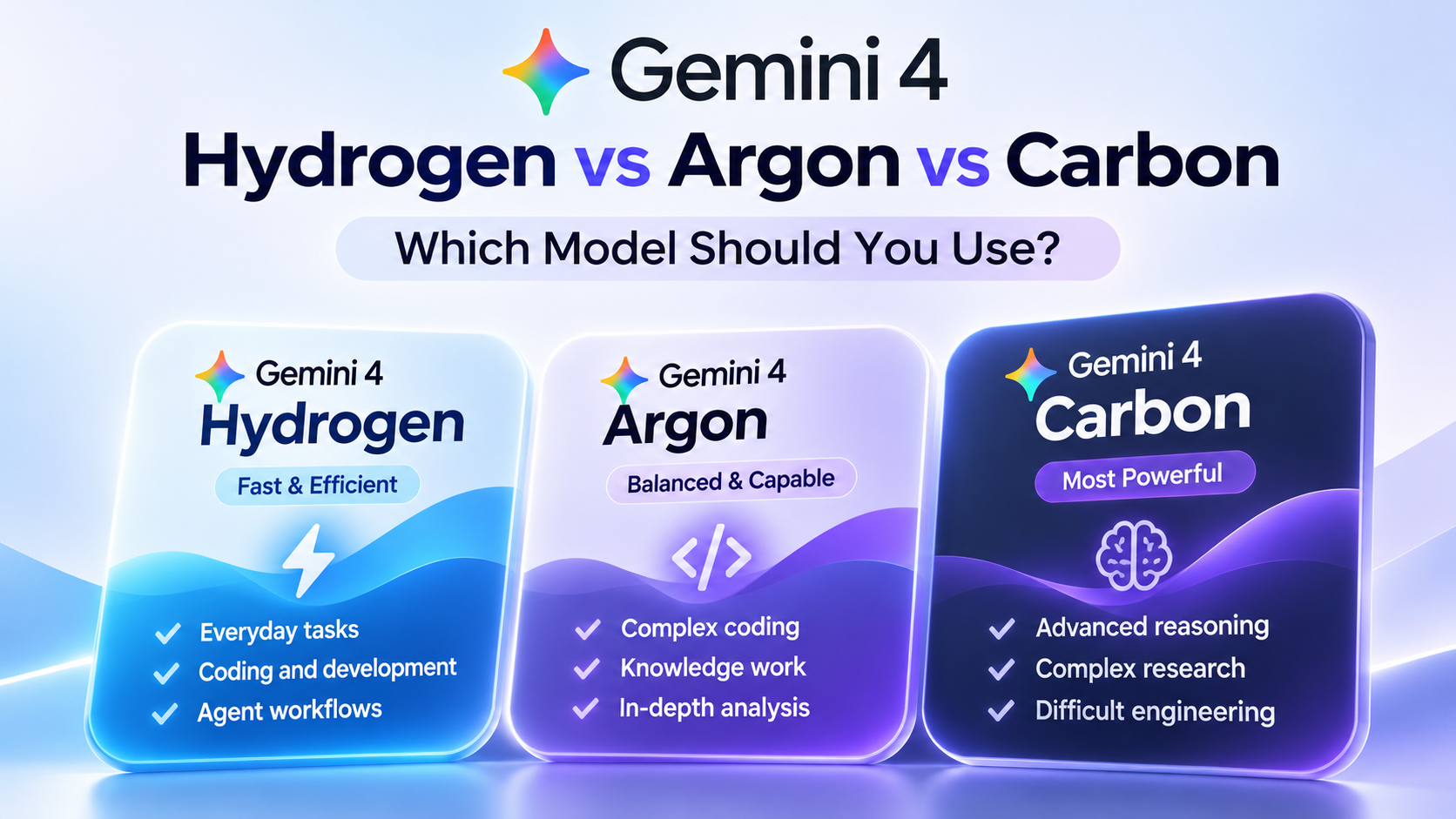
Hydrogen focuses on speed, efficiency, and everyday AI workflows. Argon balances advanced reasoning with practical performance, while Carbon targets the most demanding coding, research, and multi-step reasoning tasks.
And perhaps surprisingly, the newest model isn’t necessarily the most powerful—or the weakest.
In this guide, we compare Gemini 4 Hydrogen vs Argon vs Carbon across performance, coding, reasoning, pricing, and real-world use cases to help you choose the right model.
Gemini 4 Hydrogen vs Carbon vs Argon: Quick Comparison
Here’s how the three models compare at a glance.
| Feature | Gemini 4 Hydrogen | Gemini 4 Argon | Gemini 4 Carbon |
|---|---|---|---|
| Release date | Nov 12, 2026 | Oct 13, 2026 (general availability) | Nov 10, 2026 (broader availability) |
| Primary focus | Speed and efficient execution | Balanced frontier reasoning | Maximum reasoning depth |
| Best for | Daily tasks, coding, automation | Complex coding and knowledge work | Difficult research and advanced engineering |
| Reasoning capability | High, configurable | Advanced | Deepest overall |
| Speed priority | High | Balanced | Lower priority than reasoning depth |
| Context window | Up to 1M tokens | Up to 1M tokens | Up to 1M tokens |
| API free tier | Yes | No | No |
| Input price / 1M tokens | $1.50 | $2.00* | $2.00* |
| Output price / 1M tokens | $7.50 | $10.00* | $10.00* |
Prices are in USD for standard paid Gemini API usage as of November 14, 2026. Argon and Carbon have introductory pricing through November 30, with published increases scheduled for December 1. Output pricing includes thinking tokens.
Our Quick Recommendation
Choose Gemini 4 Hydrogen if you want a fast, capable AI model for everyday tasks, writing, web development, coding, or frequent automation.
Choose Gemini 4 Argon if you regularly work on complex programming, detailed analysis, or professional tasks requiring stronger reasoning.
Choose Gemini 4 Carbon if you need Google’s most capable reasoning model for difficult engineering problems, scientific research, or long-running autonomous workflows.
For most users, we recommend starting with Hydrogen and moving to Argon or Carbon only when a particular task requires more advanced reasoning.
What Is Gemini 4 Hydrogen?
Gemini 4 Hydrogen is the newest member of Google’s Gemini 4 family.
Released on November 12, 2026, Hydrogen was designed to make advanced AI capabilities available to a broader audience without the high costs or extended processing times associated with the largest frontier models.
Google describes Hydrogen as particularly well suited to everyday coding, agentic workflows, and rapid task execution.
What Makes Hydrogen Different?
The most important distinction is efficiency.
Hydrogen is designed to complete many practical tasks quickly while maintaining strong reasoning performance.
Its primary strengths include:
- Everyday writing and content creation.
- Software development and debugging.
- Interactive web development.
- Working with documents, spreadsheets, and other files.
- Multi-step automation.
- AI agents that repeatedly call tools or perform tasks.
- Fast iteration and prototyping.
Hydrogen also introduces four configurable thinking levels:
- Low: Prioritizes responsiveness and lower reasoning overhead.
- Medium: Balances speed and complexity.
- High: The default setting, intended for strong general performance.
- Xhigh: Allows additional reasoning for more demanding problems.
This flexibility matters because not every task needs the same amount of computation.
Summarizing an email and solving a difficult software engineering problem require very different levels of reasoning.
With Hydrogen, developers can adjust how much reasoning the model performs instead of always using the same configuration.
Is Hydrogen Actually Powerful?
Yes—and this is where the comparison becomes interesting.
Google reports that Hydrogen achieves a score of 51 on the Artificial Analysis Intelligence Index at its default high thinking level, compared with 50 for Argon.
At its maximum xhigh setting, Hydrogen reaches 54.
That means Hydrogen can compete with Argon on broad intelligence evaluations despite being positioned as the faster, more efficient model.
However, a single benchmark score doesn’t prove that Hydrogen is better for every task.
Models can perform differently depending on the problem, available tools, reasoning configuration, and evaluation methodology.
Our assessment: Hydrogen is a compelling default because it combines strong intelligence, lower API pricing, and flexible thinking controls.
For many users, paying for a larger model on every request may offer little practical benefit.
What Is Gemini 4 Argon?
Gemini 4 Argon became generally available on October 13, 2026.
It was Google’s first broadly accessible frontier model in the Gemini 4 family, built to handle complex tasks across software engineering, scientific research, mathematics, and professional knowledge work.
Compared with Hydrogen, Argon puts greater emphasis on sophisticated reasoning and sustained problem-solving.
Where Does Argon Perform Best?
Argon is particularly suitable for:
- Complex programming and debugging.
- Analyzing large codebases.
- Multi-step mathematical problems.
- Financial and legal research.
- Detailed technical documents.
- Scientific and analytical workflows.
- Autonomous agents requiring extended reasoning.
For example, if you’re asking an AI model to summarize a short document, Hydrogen may be sufficient.
But if you need to analyze a lengthy technical report, identify conflicting assumptions, evaluate several alternatives, and develop a defensible recommendation, Argon becomes more attractive.
Google positions Argon as the practical frontier reasoning choice for the majority of complex software engineering and knowledge-work tasks.
Is Argon Still Worth Using After Hydrogen?
Yes, but the decision is less obvious than it was before Hydrogen launched.
Hydrogen’s improved performance means some workloads that previously required Argon may now run efficiently on a less expensive model.
That doesn’t make Argon obsolete.
Argon remains a strong option for demanding tasks, particularly when an existing workflow already performs reliably with it.
If you’re developing a production application, switching models purely because a newer one was released isn’t necessarily a good idea.
You should first verify whether Hydrogen can match Argon’s accuracy, reliability, and tool behavior on your actual workload.
Our assessment: Argon is still a useful middle ground between efficient execution and maximum reasoning depth, especially for established professional workflows.
What Is Gemini 4 Carbon?
Gemini 4 Carbon is Google’s most capable reasoning model in the current Gemini 4 lineup.
Originally announced on October 28, it became broadly available on November 10, 2026.
Google developed Carbon for problems that require deeper reasoning, longer task execution, and extensive verification.
Unlike Hydrogen, which prioritizes efficient task completion, Carbon is designed to spend more computational effort solving particularly difficult problems.
What Makes Carbon Different?
Carbon’s strengths include:
- Advanced software architecture.
- Complex multi-file debugging.
- Long-running agentic coding.
- Difficult scientific and mathematical research.
- Cybersecurity analysis.
- Multi-step knowledge work.
- Problems requiring extensive checking and verification.
Imagine asking an AI model to investigate an intermittent bug affecting a large software system.
A smaller model might identify obvious problems or suggest fixes based on familiar patterns.
Carbon is designed for deeper investigation, including tracing complicated dependencies, evaluating alternative explanations, and verifying possible solutions.
That additional reasoning can be valuable when mistakes are expensive.
Is Carbon the Most Intelligent Gemini 4 Model?
Google positions Carbon as its strongest overall reasoning model.
In the Artificial Analysis Intelligence Index v5.0 results published with Carbon, it scored 59, compared with Argon’s 50.
Carbon also shows improvements on several advanced coding, reasoning, and cybersecurity evaluations.
However, these results shouldn’t be interpreted as proof that Carbon wins every benchmark or every real-world task.
Different models may perform better on different workloads, and publicly reported evaluations don’t always use identical configurations.
Another important consideration is computational cost.
Carbon may spend more tokens reasoning through complicated tasks, increasing actual API costs even when its published per-token price matches Argon’s.
Our assessment: Carbon makes the most sense when solving a difficult problem correctly is more important than minimizing latency or token usage.
For ordinary writing, summarization, and straightforward programming, its additional reasoning capability may be unnecessary.
Gemini 4 Hydrogen vs Argon vs Carbon: Which Is Best for Coding?
Coding is one of the most important reasons to compare these models.
All three support software development, but their ideal roles are different.
Hydrogen: Best for Everyday Coding
Hydrogen is an excellent starting point for common development tasks.
Examples include:
- Building a simple website.
- Writing or updating components.
- Fixing straightforward bugs.
- Generating unit tests.
- Explaining existing code.
- Refactoring a function.
- Creating scripts and automation tools.
Google specifically optimized Hydrogen for rapid iteration and precise modifications, including avoiding unnecessary changes to unrelated code.
This makes it attractive for interactive development, where developers frequently make small requests and expect quick responses.
Argon: Best for Complex Development Work
Argon becomes useful when tasks involve more complicated reasoning.
For example:
- Understanding a large application architecture.
- Debugging issues involving multiple services.
- Evaluating alternative implementations.
- Refactoring interconnected systems.
- Planning sophisticated application features.
It offers a strong balance between frontier-level reasoning and practical deployment.
If Hydrogen consistently struggles with a particular development problem, Argon is a reasonable next model to try.
Carbon: Best for Difficult Engineering Problems
Carbon is designed for the most challenging coding and engineering workloads.
It may be especially valuable when:
- A bug has resisted several earlier attempts.
- Multiple systems interact in unexpected ways.
- A change requires extensive architectural judgment.
- Security and reliability requirements are demanding.
- An autonomous agent must manage a long, complicated workflow.
However, it isn’t automatically the most efficient option for every developer.
A simple bug that Hydrogen can fix in one attempt doesn’t necessarily benefit from Carbon’s deeper reasoning.
Our Coding Recommendation
| Coding Task | Recommended Model |
|---|---|
| Basic scripts and functions | Hydrogen |
| Frontend development | Hydrogen |
| Unit tests and routine debugging | Hydrogen |
| Large codebase analysis | Argon |
| Complex multi-service debugging | Argon or Carbon |
| Software architecture review | Carbon |
| Difficult long-running coding agents | Carbon for planning, Hydrogen for execution |
These are starting recommendations based on the models’ documented capabilities, not the results of an independent coding test conducted by our team.
Which Gemini 4 Model Is Best for Everyday AI Tasks?
Most people don’t use AI exclusively for complex programming or scientific research.
They use it to write emails, summarize documents, prepare presentations, brainstorm ideas, and answer questions.
For those tasks, Hydrogen is our recommended starting point.
Writing and Content Creation
Hydrogen offers a strong combination of speed, instruction following, and output quality.
It is suitable for:
- Blog outlines and drafts.
- Email writing.
- Social media content.
- Marketing copy.
- Editing and rewriting.
- Summarizing meetings and documents.
Argon or Carbon may be worth trying when the task requires unusually complex analysis or reconciliation of extensive source material.
However, using a more powerful model doesn’t automatically produce better writing.
For editorial work, quality also depends on source reliability, clear instructions, fact-checking, and human review.
Research and Document Analysis
All three models support large context windows and multimodal inputs.
Hydrogen may be sufficient for extracting key information from documents, summarizing reports, or analyzing straightforward datasets.
Argon is a useful choice for research requiring deeper interpretation.
Carbon becomes more attractive when the work involves challenging analytical questions, contradictory evidence, or extended reasoning.
Importantly, none of these models should be treated as an automatically reliable source of current facts.
For up-to-date research, use supported search or grounding tools and verify important claims against primary sources.
Business and Professional Work
For everyday business tasks, Hydrogen is often the most practical option.
Argon is well suited to more demanding analytical work, while Carbon may be justified for especially complex problems.
For legal, financial, medical, or similarly high-stakes decisions, AI outputs should be independently reviewed by appropriately qualified people regardless of the model used.
Gemini 4 Pricing: How Much Do Hydrogen, Argon, and Carbon Cost?
Pricing is one of the clearest differences between the three models.
Google has published the following standard Gemini API prices as of November 14, 2026.
Current API Pricing
| Model | Input / 1M Tokens | Output / 1M Tokens | Free API Tier |
|---|---|---|---|
| Gemini 4 Hydrogen | $1.50 | $7.50 | Yes |
| Gemini 4 Argon | $2.00 | $10.00 | No |
| Gemini 4 Carbon | $2.00 | $10.00 | No |
Prices shown in USD. Argon and Carbon currently have introductory pricing through November 30, 2026. Output rates include reasoning tokens.
Important: Argon and Carbon Prices Are Scheduled to Increase
Google’s pricing documentation lists the following rates beginning December 1, 2026:
| Model | Input / 1M Tokens | Output / 1M Tokens |
|---|---|---|
| Gemini 4 Hydrogen | $1.50 | $7.50 |
| Gemini 4 Argon | $4.00 | $20.00 |
| Gemini 4 Carbon | $4.00 | $20.00 |
This would make Hydrogen significantly less expensive per token than the other two models.
Developers should also remember that API costs aren’t determined solely by visible response length.
Thinking tokens count toward output usage, and models performing more extensive reasoning may generate substantially more billable tokens.
That means Carbon and Argon can have different costs per completed task even when they share identical token rates.
For API-based applications, the most useful cost metric is often the total cost of successfully completing a task, rather than just the price per million tokens.
Is Gemini 4 Hydrogen Free?
Yes, Hydrogen is available through a limited free tier of the Gemini API and Google AI Studio.
However, free access comes with usage limits, and availability may depend on the service or account.
Argon and Carbon do not have free Gemini API tiers.
Consumer subscriptions are separate from API billing. Access through the Gemini app or Google AI plans should not be confused with free API usage.
For current pricing and limits, refer to Google’s official Gemini API pricing page.
Does a Bigger Context Window Make Carbon Better?
Not necessarily.
All three Gemini 4 models support a unified context window of up to one million tokens.
That allows them to process substantial amounts of text, code, or multimodal information.
However, context capacity and reasoning quality are different things.
A model may technically accept a large document without identifying every important detail in it.
Likewise, a model with deeper reasoning capabilities may be better at connecting subtle information across a large amount of material.
The right choice depends on what you need to do with the context.
For summarizing a large document, Hydrogen may be sufficient.
For analyzing intricate relationships across many documents, Argon or Carbon may be more appropriate.
It’s also worth testing performance with your actual documents rather than assuming that identical context-window specifications guarantee identical results.
Can You Use Hydrogen and Carbon Together?
Yes, and this may be one of the most interesting developments in Gemini 4.
Rather than selecting one model for an entire workflow, Google is introducing ways to combine models with different strengths.
Its new Orchestrator feature in Google Antigravity can dynamically route work between models such as Carbon and Hydrogen.
The basic idea is straightforward:
- A stronger reasoning model analyzes a difficult problem and develops a plan.
- A faster model executes routine steps or writes code.
- Additional agents test, verify, or review the results.
- The workflow returns to a stronger model when deeper judgment is required.
Google reported that this approach achieved results close to Carbon on Terminal-Bench 4.0 while using 24% less quota and completing tasks 19% faster on average in the cited evaluation.
Those results come from Google’s reported testing, not our own benchmark.
Still, the approach illustrates an important direction for AI applications.
The most efficient AI system may not use the same model for every step.
Developers may increasingly combine lightweight execution models with stronger reasoning models, balancing speed, quality, and operating cost.
Which Gemini 4 Model Should You Choose?
Here’s our recommendation for different types of users.
For Students and Everyday Users: Hydrogen
Start with Gemini 4 Hydrogen.
It provides strong general capabilities, broad availability, and access through Google’s free options.
For studying, writing, brainstorming, document summaries, and everyday questions, it is the most sensible starting point.
For Content Creators and Marketers: Hydrogen
Hydrogen should be sufficient for many content creation and marketing workflows.
It can help with research organization, drafting, editing, content planning, and repetitive tasks.
Consider Argon when a project requires deeper strategic analysis across substantial evidence.
For Software Developers: Hydrogen or Argon
Hydrogen is our default recommendation for everyday coding and rapid iteration.
Argon is worth considering for more demanding software engineering tasks.
Use Carbon selectively for problems that genuinely benefit from deeper reasoning.
For Researchers and Analysts: Argon
Argon offers an attractive balance for complex knowledge work.
It is a good starting point for detailed reports, technical analysis, and professional research.
Carbon may be justified when tasks require extensive reasoning or involve particularly difficult scientific and engineering challenges.
For Advanced AI Agents: Carbon + Hydrogen
For sophisticated multi-agent systems, consider combining models.
Carbon can handle complex planning and reasoning, while Hydrogen can execute repeated steps more efficiently.
However, this architecture introduces its own complexity, and a single-model workflow may still be preferable for simpler applications.
Frequently Asked Questions
Is Gemini 4 Hydrogen Better Than Argon?
Not in every situation.
Hydrogen delivers competitive performance on some broad intelligence evaluations while offering faster execution and lower API pricing.
Argon remains designed for complex reasoning and sustained professional workflows.
Which one performs better depends on the task and configuration.
Is Gemini 4 Carbon the Most Powerful Model?
Google positions Carbon as the strongest overall reasoning model in the Gemini 4 family.
However, that doesn’t mean it is automatically the fastest, cheapest, or best choice for every application.
Is Gemini 4 Hydrogen Free?
Hydrogen offers a limited free API tier and is available through supported Google AI products. Usage limits and consumer subscription access vary.
Which Gemini 4 Model Is Best for Coding?
Hydrogen is our recommendation for everyday coding, web development, and rapid iteration.
Argon is a strong option for complex development tasks, while Carbon is intended for the most demanding engineering problems.
What Is the Difference Between Gemini 4 Argon and Carbon?
Argon balances advanced reasoning with practical efficiency.
Carbon prioritizes maximum reasoning capability and more extensive problem-solving, often using additional tokens and processing time.
Do All Gemini 4 Models Support One Million Tokens?
Yes. Google documents a unified context capacity of up to one million tokens for Hydrogen, Argon, and Carbon.
Actual performance with long inputs can vary by task, and the context limit should not be interpreted as a guarantee of perfect recall.
Can I Use Gemini 4 in Google AI Studio?
Yes. Hydrogen is available through free and paid access, while Argon and Carbon require paid API access.
Should I Switch From Gemini 4 Argon to Hydrogen?
If you’re using Argon for everyday coding, content generation, or frequent automated tasks, Hydrogen is worth evaluating.
However, don’t switch a production workflow without testing output quality, latency, reliability, and actual cost.
Final Verdict: Hydrogen, Argon, or Carbon?
Google’s Gemini 4 lineup reflects a shift away from treating the most powerful AI model as the automatic best choice.
The three models serve different needs.
Gemini 4 Hydrogen is our best overall recommendation for most users. It combines strong intelligence with faster execution, flexible thinking levels, and lower API pricing.
Gemini 4 Argon remains an excellent choice for complex professional tasks, particularly when deeper reasoning and consistency matter more than minimizing cost.
Gemini 4 Carbon is the model to consider for the hardest problems, including advanced engineering, scientific reasoning, and sophisticated agentic workflows.
For developers and businesses, the most practical strategy is to start with Hydrogen, evaluate whether it meets the required quality standard, and move to Argon or Carbon when the added reasoning capability provides measurable value.
The biggest takeaway is simple:
The best AI model isn’t always the most powerful one. It’s the model that solves your specific problem reliably, efficiently, and at a reasonable cost.
Sources
- Google — Introducing Gemini 4 Hydrogen (November 12, 2026)
- Google — Gemini 4 Carbon Is Now Available (November 10, 2026)
- Google — Gemini 4 Argon: Built to Solve Your Hardest Problems (October 13, 2026)
- Google — Gemini Developer API Pricing
- Google DeepMind — Gemini 4 Hydrogen Model Card
- Google DeepMind — Gemini 4 Carbon Model Card
- Google DeepMind — Gemini 4 Argon Model Card
Editorial note: This comparison is based on official documentation, published evaluations, and product specifications available as of November 14, 2026. We have not independently benchmarked all three models under identical testing conditions. Recommendations reflect their documented capabilities and intended use cases.
Leave a Reply